20 official U.S. State Dinosaurs: what you need to know to impress your dinosaur fan
Do you live in a state with an official state dinosaur? Find out more about these wonderful beasts and why they were chosen to be the official state emblem. And what you and your little dinosaur fan can do to have your state adopt its own official state dinosaur.


Does it feel like your little dinosaur fan knows much more about dinosaurs than you do?
Did you know, for example, that 18 States have official state dinosaurs?
But which dinosaurs? And which states? And why are there 20 dinosaurs but only 19 states?
We’ll unravel these and other intricacies and abnormalities about the 20 official U.S. state dinosaurs so that you can easily impress your little dinosaur fan with your knowledge.
How does a fossil become an official U.S. State dinosaur?
States decide whether to make something, like a dinosaur, an official state symbol. The process will depend on the law of the relevant State.
States are not required to have an official state fossil or an official state dinosaur. Currently, only 14 states have an official state dinosaur. Six states do not have an official state fossil (Arkansas, Hawaii, Iowa, New Hampshire, Rhode Island and Texas), although two of them (Arkansas and Texas) do have official state dinosaur symbols.
Generally, to make a dinosaur an official state symbol, a member of the State legislature will have to present a bill proposing the designation. In most cases, a group of constituents will approach a member with the idea and ask the member to sponsor the bill.
Once the bill is presented to the legislature, it will take the same path that all other bills take through the lower and upper houses to be adopted, before being signed into law by the governor.
In some cases, the bill will be put to a public vote.
Tip: The most recent inductee into the list of official U.S. State dinosaurs started as a teacher’s idea to teach his fourth grade class about history, civics, letter writing, and even maths. The class researched dinosaurs found in the state, learned about the legislative process and wrote to state officials to have the dinosaur designated the official state dinosaur. If your state does not have an Official State dinosaur symbol yet, perhaps you can work with your little dinosaur fan to gather public support and start the process to have their favourite local dinosaur become the official dinosaur of your state.
Get our free dinosaur printables
When you join our newsletter
Official U.S. State Dinosaurs
Dinosaur remains have been found in 24 of the 50 U.S. states. Potentially, there could be 24 official U.S. State dinosaurs, or at least official dinosaur symbols for 24 States.
But there’s not. Yet.
Official U.S. State dinosaur of the State of Arkansas: Arkansaurus fridayi
The dinosaur that made it 25.
In 1972, service station owner, Joe B Friday noticed vultures circling above his land. Upon investigation, he found fossilised bones that had been uncovered by roadworks. Friday put them on display in his service station.
Months later, a geology professor from the University of Arkansas saw the bones on display and recognised their significance. He showed them to palaeontologist, Dr James Quinn. Quinn thought they were the foot bones of an Ornithomimus.
Dr Quinn originally intended to name the species Arkansarurus fridayi, but was fatally injured before he could. In 2018, the full species name, Arkansaurus fridayi was first published, a year after it became the official state dinosaur of Arkansas.
Arkansaurus is an ornithomimosaurian (bird mimic) theropod and is the sole dinosaur discovered in Arkansas.
It was around 1.8 to 4.6 m tall and was probably quite fast. It had three-fingered grasping hands on the end of long arms. Its curved foot claws are unusual for an Ornithomimus.
Arkansas had an interesting reason for adopting an official State dinosaur emblem: it would bring the number of official State symbols to 25. Unsurprisingly, in 2017, the 25th State to enter the Union adopted Arkansaurus fridayi as the official state dinosaur.

Official U.S. State dinosaur of the State of Arizona: Sonorasaurus thompsoni
Arizona decided to go big or go home.
In 1994, Geology student Richard Thompson discovered the only fossils of the Sonorasaurus in a rock wall in the Chihuahua Desert/Sonoran Desert in southern Arizona. Ronald Ratkevich, a palaeontologist working at the Sonoran Desert Museum, secured the bones.
At first, Ratkevich thought the fossils were those of a sauropod, but there was much uncertainty.
He showed them to David Thayer, the curator of geology for the Museum, who thought they might be a Therizinosaur. He mistook a tailbone for a hand claw
When Edwin Colbert, the Curator of Vertebrate Palaeontology for the American Museum of Natural History, saw pictures of the fossils, he thought it might be a Hadrosaur (Kritosaurus).
Finally, in 1998, Ratkevich identified Sonorasaurus as a relative of the Brachiosaurus. The herbivorous sauropod was the oldest known brachiosaurid to live in North America (112 to 93 MYA). It is estimated to have been about 15 metres long and 8.2 metres tall (about one-third the size of the Brachiosaurus).
It has been the official state dinosaur of Arizona since April 2018.

Official State Dinosaur of the State of California: Augustynolophus morrisi
California’s state dinosaur is the unpronounceable new kid on the block: Augustynolophus Morris.
This hadrosaur (duck-billed dinosaur) is the “youngest” dinosaur found and lived only 66 MYA.
As the name suggests, Augustynolophus was similar to one of my favourite dinosaurs, the Parasaurolophus, and had a smaller crest.
The fossils were discovered in 1939 in the Panoche Hills of Fresno County. So far, Augustynolophus has only been found in California.
Few other dinosaurs have been found in the State. This made it easy to choose the Californian State Dinosaur. In 2017, California designated the Augustynolophus as the official state dinosaur.

Official State Dinosaur of the State of Connecticut: Dilophosaurus
Connecticut’s official state dinosaur is well-known but is not like you know it.
Connecticut designated Dilophosaurus its official state dinosaur in 2017.
Dilophosaurus, the “two-crested lizard” was a carnivorous dinosaur identified by its double crests. It lived in what is now Connecticut during the Jurassic period.
The first Jurassic Park film portrays Dilophosaurus as a small dinosaur with crests and a frill that spat venom.
The real Dilophosaurus had crests but no frill. It was much larger, at around 7 m long. And it did not spit venom.
Connecticut designated Dilophosaurus its official state dinosaur in 2017.

In 1998, Dilophosaurus nearly became the official state dinosaur of Arizona. The proposal was vetoed when it was revealed that the Dilophosaurus fossils were taken illegally from the Navajo Nation.

Official State Dinosaur of the State of Maryland: Astrodon johnstoni
When dentists name dinosaurs…
In 1858, two dinosaur teeth were discovered in an open iron ore pit in Swampoodle in Maryland. They were given to Christopher Johnston, a dentist, to study. He cut one in half and discovered a characteristic star-formed cross-section, and named the dinosaur Astrodon as a result (aster means star, odon is tooth).
Unfortunately, Johnston didn’t attach an epithet (the second part of the name, in this case, johnstoni). He missed out on naming the second dinosaur species identified in the USA.
Astrodon is a large herbivorous sauropod related to Brachiosaurus. It lived in the Early Cretaceous period around 112 MYA in what is now the northeastern United States. It was estimated at more than 9 m high and 15 to 18 m long.

Official State Dinosaur of the State of Missouri: Parrosaurus missouriensis
Until 2021, the fossilised bones of Parrosaurus missouriensis were the first and only dinosaur bones discovered in Missouri.
“Dino Dan” Stewart of the Missouri Geological Survey was researching the clay deposits in the southern Ozarks in 1942 when an 8-year-old boy told him about some bones. The Chronister family had found them while digging a well. Dan convinced the Chronisters to sell the fossils to the Smithsonian.
Originally, the dinosaur was identified as a sauropod and named Neosaurus missouriensis. In 1945, it was identified as a duck-billed hadrosaur and renamed Parrosaurus. In 1979, it was renamed again to Hypsibema. Finally, in 2018, the name was changed back to Parrosaurus missouriensis.
Parrosaurus weighed 2.7 to 3.6 tonnes, and was 3 m tall and about 10 m long. The herbivore had around 1,000 teeth to eat quite tough vegetation. It lived during the Late Cretaceous period (83 to 72 MYA).
In November 2021, St Genevieve Museum Curator Guy Darrough announced the discovery of more fossils in Missouri. His team found bones of an adult and a juvenile Parrosaurus at the Chronister site.
Parrosaurus became the official State Dinosaur of Missouri in 2004.

Official State Dinosaur of the State of Texas: Sauropoiseidon proteles
The “Lizard Earthquake God” is the official state dinosaur of Texas.
Initially, the fossils were thought to be petrified wood because of their age and size. Five years and a media frenzy later and it was discovered that the wood was in fact bone.
Sauropoiseidon is an early Cretaceous sauropod known from various incomplete specimens and trackways.
Sauropoiseidon lived on the shores of the Gulf of Mexico and grew to be an estimated 34 m long and 18 m high. It was possibly the tallest dinosaur to ever live. Weighing an estimated 40 to 60 tonnes, it is one of the heaviest, too. Initially, Sauropoiseidon was thought to be a Brachiosaur. If it is instead a titanosaur, these estimates would be inaccurate.
Paluxysaurus jonesi was the original Texan State Dinosaur. However, later reclassification of the Paluxysaurus specimen to Sauropoiseidon meant the official state dinosaur of Texas had to change, too.
And to think, these fossils may still be languishing in a collection thought to be just some large pieces of prehistoric wood…

A bounty of new Official State Dinosaurs!
The last 12 months have seen the designation of not one, not two, but three new official state dinosaurs.
Most of these designations were delayed due to more urgent COVID legislation. Perhaps it was the general desire to push through some very simple, positive legislation that saw the flurry of action.
Either way, we are happy to welcome these three new official state dinosaurs to the fold.
Interestingly, all three designations have something else in common. they stem from a desire to teach children about the passage of a bill through parliament.
Official State Dinosaur of the Commonwealth of Massachusetts: Podokesaurus holyokensis
Podokesaurus holyokensis was found by Mignon Talbot in 1910 near Mount Holyoke College, where she was a professor. She was the first female scientist in the world to name and describe a dinosaur.
This small dinosaur with a “light and delicate frame” is similar to Coelophysis. It lived in Massachusetts 195-180 MYA.
To earn their “Digging in the Past” pins, a group of scouts organised an online poll to choose the new state symbol. It was one of only two dinosaurs found in the State (the other was Anchisaurus polyzelus), which made choosing candidates easy.
More than 35,000 votes were cast. Podokesaurus is the most democratically-selected state dinosaur to date.
The two bills were presented to the State Parliament in February 2021. In October 2022, Massachusetts Governor Baker signed a ceremonial bill, designating the Podokesaurus as the official state dinosaur of Massachusetts.
The scouts now have their official state dinosaur, AND their pins.
Party tip: Podokesaurus poke bowls
At a recent dinosaur-themed birthday party, we served Podokesaurus poke bowls, with mini dinosaurs (dinosaur-shaped chicken nuggets), prehistoric eggs, and herbivore snacks (various vegetables). The flexibility was great – our guests could take as much or as little as they wanted and create their own bowl. As an added bonus, our female guests got to learn about the first dinosaur that was named by a female.

Official Dinosaur of the State of Washington: Suciasaurus rex
The Suciasaurus rex almost became official U.S. state dinosaur number 17.
After being contacted by the fourth-grade class from Elmhurst Elementary in Parkland, Democratic Representative Melanie Morgan submitted a bill that would make this carnivorous predator the official state dinosaur for Washington. It is the only dinosaur found in Washington (and likely the last due to the state’s geology) and the easy choice.
In 2021, Legislators overturned the “Dino-mite bill”, deeming it to be of too low importance in the middle of a pandemic.
Suciasaurus rex lived about 88 MYA and is a smaller forerunner to Tyrannosaurus rex (it lived about 15 million years earlier).
The exact nature of the dinosaur has not been determined, so it does not yet have an official species name. Suciasaurus rex is a nickname.
A second-round attempt resulted in the designation of a new official state dinosaur in May 2023.
Suciasaurus rex lived about 88 MYA and is a smaller forerunner to Tyrannosaurus rex (it lived about 15 million years earlier).
The exact nature of Saciasaurus has not been determined, so it does not yet have an official species name (it may be a Daspletosaurus). Suciasaurus rex is a nickname: part of the left femur of a therapod dinosaur was found at Sucia Island state park.

The newest Official State Dinosaur: Idaho’s Oryctodromeus cubicularis
A grassroots effort spearheaded by Mr Walton’s 4th Grade class at Ucon Elementary School saw the Oryctodromeus catapulted to Official State Dinosaur of Idaho while the class learned about history, civics and even maths.
On 31 March 2023, Brad Little, Governor of Idaho, signed the Senate Bill to designate the herbivorous Oryctodromeus as Idaho’s first state dinosaur. The bill passed both chambers unanimously and garnered much support, not just from Mr Walton’s class but from classes all over the state.
When the law entered into force on 6 July 2023, Oryctodromeus became the 20th Official U.S. State Dinosaur. And we’re celebrating.
Oryctodromeus was discovered in 2006 and fossils have only been found in Eastern Idaho and SW Montana. Palaeontologists have uncovered hundreds of bones from 10 to 12 skeletons from young to fully-grown specimens. It is the most common dinosaur found in Idaho, one of the reasons it was chosen as the Official State Dinosaur.
Described as the dinosaur version of a prairie dog, Oryctodromeus cubicularis means digging runner of the lair because it was small and quick and found in burrows similar to those of hyenas and puffins. It is the first known non-avian burrowing dinosaur, with adaptations in the jaw, forelimbs, and pelvis to help it move and manipulate soil and a long tail to help it balance while digging.
The herbivorous dinosaur lived approximately 95 MYA and grew to be 2.1 metres long and weighed an estimated 23 to 32 kg.
Oryctodromeus lived in family groups, with juveniles and older dinosaurs found sharing nests. Some evidence also indicates that Oryctodromeus also shared its burrow with smaller animals. They were most active at dusk and dawn.
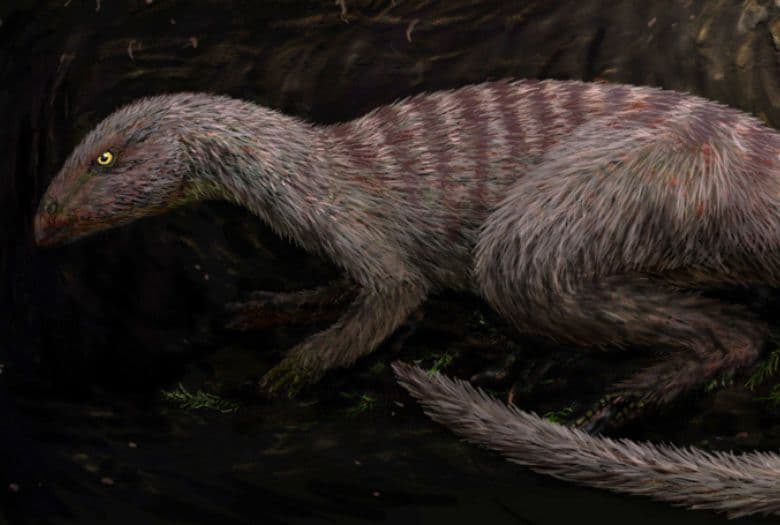
Official U.S. State fossils that are dinosaurs
More than 40 States have an official state fossil. The array is broad, with numerous woolly mammoths, trilobites, footprints and petrified wood.
Some official State fossils are dinosaurs.
Official State Fossil of the State of Montana: Maiasaura peeblesorum
Mrs Maiasaura is also an official state fossil!
In the badlands of western Montana, near the town of Choteau, lies Egg Mountain. In 1978, the first Maiasaura fossils were found here, together with 14 dinosaur nests, eggs, and baby dinosaurs – all Maiasaura. The find was the first evidence that dinosaurs fed and cared for their young.
More than 200 specimens have been found at Egg Mountain to date.
Each nest contained 30 to 40 eggs, about the size of ostrich eggs – petite by late Cretaceous standards. Can you imagine having 30 to 40 hatchlings to look after all at once?
The area might be a traditional breeding area for Maiasaura. Like many modern birds, Maiasaura may have migrated to the same area to lay eggs and raise young.
Maiasaura were large herbivorous Hadrosaurs that grew to about 9 metres long. They could walk on two legs or four, though juveniles tended to walk more on two legs (according to stress patterns on bones).
Like other Hadrosaurs, Maiasaura had a flat beak and thick noses. They had a small, solid crest in front of the eyes, but no spikes, horns, armour, or other weaponry. Instead, Maiasaura primarily fled in the face of danger and used the size of the herd (perhaps as large as 10,000 individuals!) as protection.

Official State Fossil of the State of New Mexico: Coelophysis bauri
New Mexico’s official state fossil is one of the earliest dinosaurs.
Coelophysis is a small carnivorous theropod that lived in the Late Triassic (225 to 190 MYA). It was not at the top of the food chain: large reptiles (which coexisted with dinosaurs), like phytosaurs and rauisuchids dominated.
Coelophysis grew to about 2 metres in length and weighed around 27 kg, like a small ostrich. Its hollow bones (its means “hollow form”) made it quick and agile. Sharp teeth and claws helped it hold and kill prey such as insects and small reptiles.
Coelophysis was discovered in 1891 in the Chinle Formation in northwestern New Mexico by David Baldwin, an employee of Edward Drinker Cope. Cope’s findings were poorly preserved. Fortunately, numerous fossils were found at Ghost Ranch, also in New Mexico in 1947.
Coelophysis has also been found in what is now South Africa and Zimbabwe.
One adult fossil was found with what appeared to be a young Coelophysis inside its rib cage. It was not a baby. Perhaps Coelophysis as a cannibal? A recent analysis showed that it was a small crocodile.

EVEN More dinosaurs
Our Dinosaur 101 series
This is the second post in our new series designed to give new Mamasaura and D-Rexes quick information about some popular and more unsusual dinosaurs. To make dino playtime and discovery fun. To help you keep up with your little dinosaur fan’s growing knowledge. And so they think you are roar-some (because you are!).
States that have both an Official State Fossil and an Official State Dinosaur
Some states are not content with just one.
Most fossils have been found in Montana, Colorado, Utah, and Wyoming. More than 6,000 different fossils have been found, for example, at a single dig site in Emery County in Utah. It is not surprising that one of these states has also decided to have two official state dinosaur symbols (though one is officially the state fossil symbol).
The Offical State emblems of the State of Oklahoma: Acrocanthosaurus and Saurophaganax
Oklahoma chose two fierce carnivores: the official state dinosaur is Acrocanthosaurus atokensis, while Saurophaganax maximum is the official state fossil.
The Acrocanthosaurus, the “high-spined lizard” was a theropod dinosaur similar to but larger than Allosaurus. It reached up to 11.5 metres in length and lived in the early Cretaceous period.
The first Acrocanthosaurus fossils were first discovered in Atoka County in southeast Oklahoma. Fran, one of the most complete skeletons was also uncovered in Oklahoma. Fran’s skull is complete, as are her arms.
Acrocanthosaurus had distinctive spikes projecting from its spine. Palaeontologists think these spines supported a thick ridge of muscle. Its skull was similar to other allosauroids.
Its claws, however, were fearsome. The six-inch-long talons could grip prey and rip flesh from bone.
The Saurophaganax, or “lord of lizard-eaters,” was also an allosaurid. It lived in Oklahoma about 151 MYA and may have been even bigger than Acrocanthosaurus, growing to 13 meters in length. It was one of the largest carnivores living in North America during the Late Jurassic period and may have preyed on Apatosaurus.
Saurophaganax maximus became the official State fossil in 2000. Acrocanthusarus became the official state dinosaur in June 2006.
Why does Oklahoma have both a state fossil and a state dinosaur? Who knows. Oklahoma seems to be very happy to determine official state symbols. They have A. LOT. At least 45. Everything from the beverage (milk) and cartoon character (Gusty), to more typical categories like flora or fauna.
Oklahoma doubles up on official state symbols, too. There are official designations for the animal (Buffalo), furbearer (raccoon), amphibian (bullfrog), fish (white or sand bass), and reptile (collared lizard) symbols, as well as an official bird (scissor-tailed flycatcher) and game bird (wild turkey), game animal (white-tailed deer), butterfly (black swallowtail) and insect (honeybee). Various songs, waltzes, a floral emblem, a flower, grass, a tree, and a wildflower are also specified.
It’s quite a collection!

The Offical State Symbols of the State of Utah: Utahraptor and Allosaurus
Utah had to make “Utah’s predator” special.
But it had already named Allosaurus as its official state dinosaur in 1988.
The Cleveland-Lloyd Dinosaur Quarry in east-central Utah has the densest concentration of Jurassic-aged dinosaur bones ever found. More than 12,000 bones belonging to at least 74 dinosaurs have been excavated from the quarry. Forty-six of these belong to Allosaurus.
While these finds have helped us deduce much about Allosaurus, it is unclear why the fossils of so many carnivores ended up in one place.
Allosaurus was the dominant predator in North America during the Late Jurassic era.

Thirty years later, Utahraptor was named the official state dinosaur of Utah, while the Allosaurus shifted to become the official state fossil.
Originally, the largest known member of the raptor family was going to replace Allosaurus as the state fossil. Instead, legislators created a separate official state dinosaur.
In 1975, a large foot claw was found at the Dalton Wells Quarry near Moab. In 1991, further remains were found at Gaston Quarry and the fossil world took notice. The species was officially named in 1993.
In 2001, bones of at least 7 individuals, including an adult, 4 juveniles, and a hatchling were found in Utah, together with an Iguanodon. Palaeontologists theorise that the Iguanodon was caught in quicksand and the Utahraptors were hunting it in a pack when they too became stuck. If this is correct, it would be one of the best-preserved predator traps ever discovered.
Utahraptor grew up to 7 m long and weighed about the same as a polar bear. It lived in North America from 130 to 125 MYA.
Utahraptor had a large curved claw measuring up to 24 cm long on its second toe and it could deliver devastating kicks at prey. Dr Alan Grant is fond of the claw.
It also had sharp claws on its hands that were used to dispatch the prey it caught. The Utahraptor could probably attack prey larger than itself.
Utahraptor was closer to the Velociraptors depicted in the Jurassic Park movies and may have provided inspiration. Utahraptor was going to be named after director Steven Spielberg (Utahraptor spielbergi) in exchange for funding for palaeontological research. However, the parties were unable to reach an agreement on the amount of funding.
This year, Utah created Utahraptor State Park, near Moab, where the find sites are located. It covers 26 square kilometres and is on our LDA’s list of places she would like to visit.

Official U.S. State fossils that are also official U.S. state dinosaurs
Some states took the easy route and adopted just one dinosaur, naming it both official state fossil and official state dinosaur.
And it was not because only one dinosaur fossil had been found in the state.
Official State fossil and Official State dinosaur of the state of Colorado: Stegosaurus
In 1982, Stegosaurus armatus was the first dinosaur designated as an official state dinosaur.
Othniel Charles Marsh found the very first Stegosaurus fossil in Colorado during the Bone Wars in 1876.
Stegosaurus was a large plant-eating dinosaur that lived 150 MYA. It is one of the most well-recognized dinosaurs due to the distinctive bony plates along its back and tail. It also has powerful defensive spikes on its tail, which are called thagomizers (after a Far Side comic).
Stegosaurus means roofed lizard. Palaeontologists originally thought the back plates were part of a turtle-like shell. While we now know they are backplates, we still don’t know their purpose. Did they regulate body temperature or change colour to warn predators or for mating?
Stegosaurus had one of the smallest brains of all dinosaurs, relative to body size. It weighed up to 10 tonnes but had a brain the size of a walnut.
Some experts thought they had a second – larger – brain in their hindquarters. This theory has since been debunked. The second “brain cavity” held glycogen, like the glycogen cavity in some birds.
Despite their dubious intelligence, Stegosaurus were incredibly successful. Fossils have been found in the US, Europe, Africa and Asia.
Sophie, the most complete Stegosaurus fossil, lives at the Natural History Museum in London.

Official State fossil and Official State dinosaur of the state of New Jersey: Hadrosaurus
New Jersey also took the easy route.
Hadrosaurus foulkii was named the official state fossil and official state dinosaur in 1991.
It was the first dinosaur ever discovered in North America.
In 1838, John Estaugh Hopkins discovered large bones while digging in a marl pit in Haddonfield. He displayed them in his home, where they caught the eye of William Parker Foulke. Foulke uncovered the full skeleton from the Marl pit later that year.
Joseph Leidy officially named the dinosaur Hadrosaurus, the “bulky lizard” in 1858. The bones were similar to those of an Iguanodon, making their identification easy.
Hadrosaurus lived 80 to 78 MYA in North America. The herbivore grew to between 7 and 8 metres long and weighed up to 4 tonnes. It had a beak made of keratin (like fingernails) and specialised teeth to help them crop foliage and process the food.
Leidy assembled the Hadrosaurus fossils and put them on display at the Philadelphia Academy of Natural Sciences. It was the first-ever mounted dinosaur skeleton in the world.

Get our free dinosaur colouring books
When you join our newsletter
The curious case of the Triceratops horridus
Triceratops horridus is an official state fossil and an official state dinosaur but of two different states.
Yes, you read that correctly.
In 1988, South Dakota designated Triceratops horridus fossil as its official State fossil, Six years later, Wyoming named the Triceratops horridus the official State dinosaur (and coincidently became the first state to have an official fossil symbol (Knightia, a fish) and a different official state dinosaur).
Why?
The first Triceratops was found in Colorado near Denver in 1887. Neither state could claim it was the first to find it.
Before 1988, the state fossil of South Dakota was the cycad, a Mesozoic palm. Legislators decided to change it to one of the most recognisable dinosaurs of all time. The Triceratops is one of the most prevalent dinosaurs found in the Hell Creek Formation and was found in South Dakota in 1927.
Had the South Dakotan legislature waited a just few more years, Tyrannosaurus Rex may have been the official state fossil. Sue, the most complete T-Rex, was found on the Cheyenne River Indian Reservation in the west of South Dakota in 1990.
Wyoming took a more democratic approach. Inspired by the release of Jurassic Park, the legislators decided to choose a state dinosaur and adopted a state statute. The 1994 statute declared that a state dinosaur would be designated by an election – of elementary school students. The winner was the Triceratops.
In 1888 the first Triceratops skull was found in Wyoming.
The herbivorous Triceratops is probably one of the most easily recognisable dinosaurs. It lived in the Late Cretaceous, 68 MYA, in what is now North America.
The Greek name – which means three-horned face – reflects the first key identifier of the Triceratops. It had a pair of brow horns approximately one metre long above each eye and a third, much smaller horn above its mouth.
The second key identifier is the huge bony frill on its head, which is studded with small spikes called epoccipitals. At 2.5 metres in length, the Triceratops skull is one of the largest of any known land animal. It made up almost a third of the entire animal’s length.
The function of the horns and frill has long inspired debate.
Traditionally, the horns were thought to be used for defence. More recent views are that the horns functioned more like antlers on a deer: for identification, courtship, and displays of dominance.
The frill is a little more mysterious.
Did it help regulate body temperature? Did it effectively function as a radiator?
Did it protect the Triceratops from predators? Did it help them recognise different ceratopsian species?
Given the extravagant frills of other Ceratopsians, courtship display was probably the primary function.

One oddity: Capitalsaurus
Although it isn’t strictly a state, the District of Columbia does have an official dinosaur symbol. But we don’t know what type of dinosaur it is.
In 1898, construction workers discovered the remains (part of a single vertebra) while working on sewers at the intersection of First and F Street SE, near Garfield Park (just four blocks from the United States Capitol).
One hundred years later, it was designated the official dinosaur fossil of the District of Columbia.
The dinosaur was identified as a theropod that lived during the Cretaceous period, but the exact classification has remained elusive.
In 1990, palaeontologist Peter Kranz unofficially referred to the remains as the Capitalsaurus – and the name stuck!

Other countries to adopt official dinosaur emblems
Official state dinosaurs and official state fossils are not unique to the USA.
Australian fossil emblems
Australia has recently adopted several official state fossil emblems.
Western Australia has the Mcnamaraspis kaprios, a prehistoric fish. New South Wales also has a fish, the Mandageria fairfaxi, which lived 370 MYA. The ACT has a trilobite fossil while South Australia has the Spriggina floudersi, a “worm” (for want of a better term). It is the oldest fossil organism to be described with a head and has only been found in South Australia.
More than 11,500 Victorians voted online to select the fossil that would become Victoria’s official fossil emblem. In January 2022, the 125 MYO amphibian Koolasuchus cleelandi was crowned the winner. Interestingly, the amphibian was selected over the Leallynasaura, an ornithopod dinosaur about the size of a wallaby.
There are now calls for an official state fossil symbol to be adopted for Queensland – and there’s a good chance it will be in a dinosaur. Candidates include the Muttaburrasaurus, a dinosaur similar to the Iguanodon with a big nose, and the Diamantinasaurus, a sauropod, as well as Cooper the Australotitan and largest dinosaur ever found in Australia.

Canadian fossil emblems
The Canadian provinces also have official dinosaurs.
The official dinosaur of the Saskatchewan province is Scotty the Tyrannosaurus Rex. Scotty was found by a high school teacher and palaeontologists in the badlands near Eastend in 1991.
Scotty is one of the most complete T-Rex skeletons ever found (about 65% intact). It is also the largest T-Rex ever found, eclipsing South Dakota’s Sue by more than half a metre.
Alberta and Edmonton have unofficial dinosaurs: the Albertosaurus and Edmontosaurus respectively (obviously).
Canada is even considering adopting a dinosaur as an official national symbol.

What will become official state dinosaur number 21?
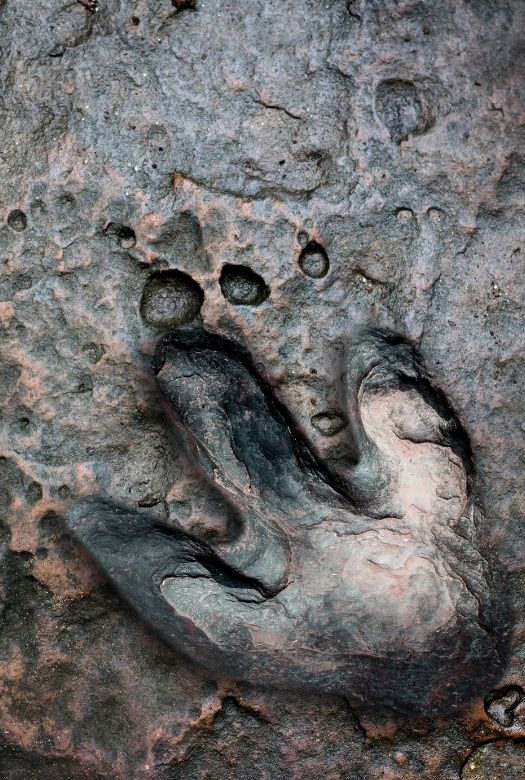
Will another teacher, scout leader or school student spearhead the designation of the next official state dinosaur? Which of the other four states where dinosaur fossils have been found will get in first? Or will we see something unexpected – can you designate an official state fossil based on footprints (ichnites)?
Whether there is public support for the adoption of an official State dinosaur or it’s just fulfilling some magic number (hello Arkansas), an official state dinosaur is a fun way to raise awareness for some of the more unusual dinosaurs.
And now you have a few more dinosaurs in your arsenal to impress your little dinosaur fan!
Do you want more regular and bite-sized information about dinosaurs? Make sure you find us on Instagram!

Save for later