The Bernissart Dinosaurs: 5 reasons why Brussels has the best dinosaur museum
The Belgian Institute for Natural Sciences is quite possibly the best dinosaur museum in the world. We’ve got 5 reasons why this is a museum you should visit, starting with the Bernissart Iguanodons.


I didn’t expect to get so close, so quickly.
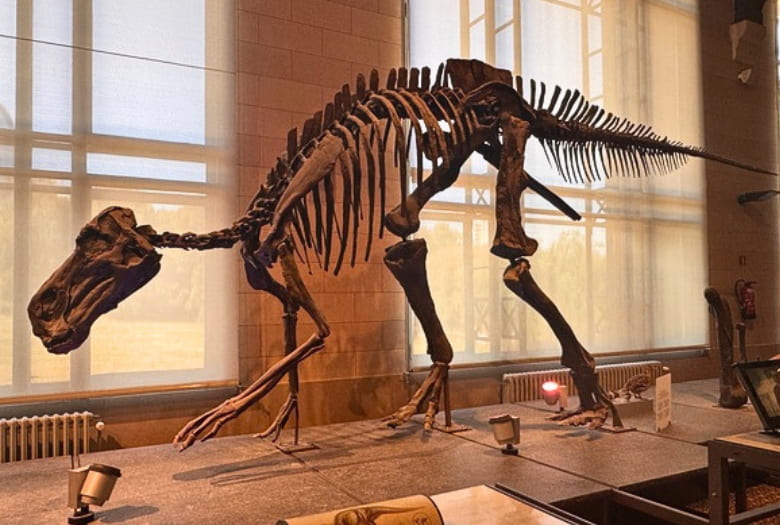
A long, dark brown jaw appeared before me, hungry soldiers standing shoulder to shoulder along it. Impressive brow bones jut over fist-sized shadows where the eyes should be. My fingers itch to caress its wide, equine nose, but a pane of glass stops me.
Once I picked my jaw up off the floor, we made our way, eyes like saucers, along the walkway to the tunnel.
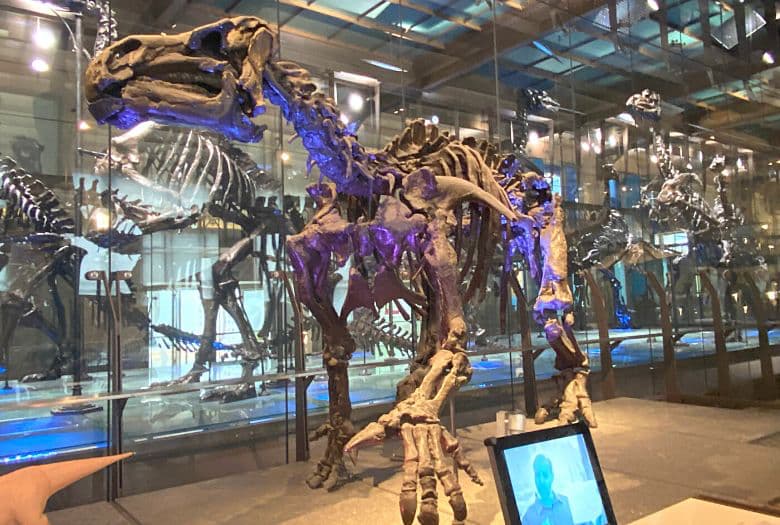
Huge herbivores surround and tower over us, adopting us into their herd. Despite their unnatural pose, the Bernissart dinosaurs are impressive.
Two words describe the dinosaurs of the Belgian Museum of Natural Sciences: underrated gem.
Not least because of the humbling herd of Iguanodons.
Brussels has the world’s best dinosaur museum (at least the best we’ve visited). Four reasons – plus one for the Bernissart Iguanodons – prove the Belgian Museum of Natural Sciences deserves the crown.

The long and short of the Belgian Museum of Natural Sciences, Brussels
OFFICIAL NAME: The Museum of Natural Sciences, part of the Belgian Institute for Natural Sciences
WEBSITE: https://www.naturalsciences.be/en
LOCATION: Rue Vautier/ Vautierstraat 29, 1000 Brussels, Belgium
OPENING TIMES: 9.30 am to 5 pm Tuesday to Friday, 10 a.m. to 6 p.m. Saturday and Sunday (closed New Year’s Day (1 January), Labour Day (1 May) and Christmas Day (25 December)
COST: Adults EUR 15; Seniors (65+) EUR 11; Students and Children 3 – 25 years EUR 6; Children 2&under free
WHAT YOU NEED TO KNOW: All information is available in the three national languages (Flemish, French, and German), as well as English.

An underrated gem
I was living in Brussels when the dinosaur gallery of the Belgian Museum of Natural Sciences reopened in 2007 after extensive renovations (which included the building of the glass case for the Bernissart Iguanodons). I visited on the reopening weekend. No one twisted my arm.
In March 2019, we visited Brussels for my birthday. I wanted to see what our resident dinosaur lover would think of the Museum. She was already a huge dinophile at 3 years old.
Three years ago and again this summer, we visited to see what had changed and if it was as good as we remembered. It was.
We have visited many dinosaur museums, including the Natural History Museum in London, Naturalis Biodiversity Centre in Leiden, and the Museum für Naturkunde in Berlin. While these Museums are fantastic, the superior Belgian Museum doesn’t get the recognition and accolades it deserves.
In 2015, CNN awarded the Museum third place in its ranking of top dinosaur museums, behind Berlin and the Field Museum in Chicago. Likewise, in 2019, The Travel awarded the Museum third place, preferring the French National Museum of Natural History in Paris and the Zigong Dinosaur Museum in China. I was not surprised. Our LDA gave it her seal of approval.
But not everyone seems to recognise how good this Museum is. It did not make Reader’s Digest’s or Trip Xtreme’s lists of the world’s best dinosaur museums.
Get our free dinosaur party printables and colouring books
When you join our newsletter
1. The star attraction: the Bernissart dinosaurs
The Museum’s dinosaur fossils are impressive. The most famous are the Bernissart dinosaurs – 30 of the 38 relatively complete iguanodon fossils discovered 322 metres down a coal mine in the town of Bernissart, near the French border, in 1878.
Belgian palaeontologist Louis Dollo and his team mounted the skeletons in St George Chapel – the only place large enough. Later, the Museum’s Dinosaur Hall was purpose-built to house these and other specimens.
Unfortunately, Dollo initially believed Iguanodons walked on two hind legs. Hardened tendons found on the fossils would stiffen the tail and restrict movement. This showed Iguanodons walked on all fours. Dollo had his team break these tendons where the tail was bent to resemble the kangaroo stance. The fossils are now too fragile for their position to be changed.
The Bernissart dinosaurs did clarify one issue. Years before, Gideon Mantell had placed the thumb spike on the Iguanodon’s nose. The complete Bernissart specimens allowed Dollo to place it correctly on the hand instead.

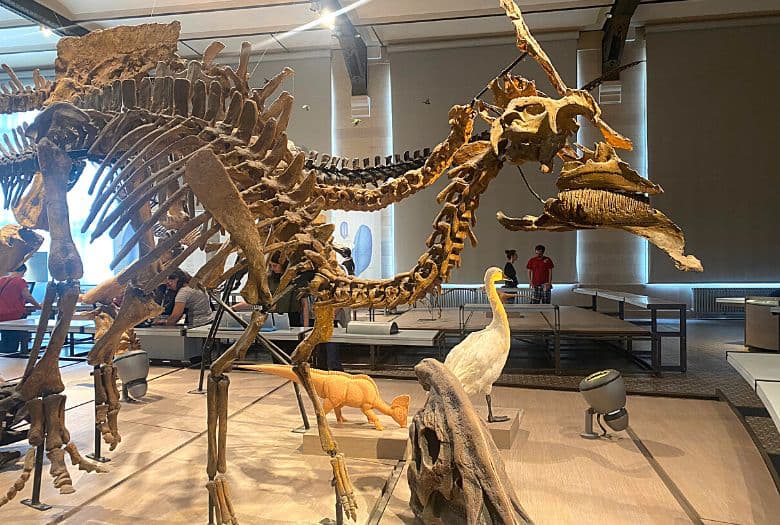
Eight of the Bernissart Iguanodons reside in a glass cube, nicknamed the cage. The cage has a tunnel, which lets visitors view the specimens up close from all angles. You can even “high five” one through the glass.
The fossils of the 22 other Bernissart dinosaurs in Brussels are displayed below the cage in their original positions as they were discovered in the mine. (One skeleton is on display at the Musée de l’Iguanodon in Bernissart).
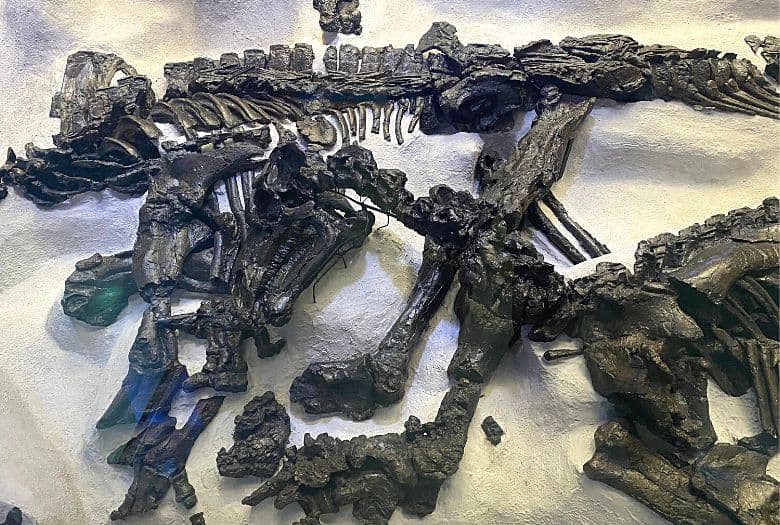
Every time I see the Bernissart Iguanodons, I am awestruck. Some dinosaurs are imposing. Some, like the mummified Edmontosaurus, are extraordinarily well preserved. The teeth, armour, horns, and other weapons (and their reputation) of other dinosaurs are impressive. The Bernissart find is exceptional.
The tunnel through the cage allows you to walk between and under the impressive specimens, go toe to toe with them, and be part of the herd. When you realise the eight Iguanodons you can see are only part of the incredible find, you recognise how outstanding the Bernissart dinosaurs are.
Are there any more Bernissart dinosaurs?
Excavating the 38 Iguanodons in the mine was not easy.
An earthquake cut off Louis De Pauw’s team for two hours in August 1878. In October 1878, a flood forced them to abandon the excavations for six months.
In 1881, the team discovered further fossils at a depth of 356 metres, and could not safely excavate them. The mine wells have since been sealed and filled.
In 2002 and 2003, the Mining Engineering Department of the Polytechnic University at Mons took core samples from the mine and produced a 3D model of the site. The samples contained fossilised bone fragments, indicating that more Iguanodons remain underground, though their condition is unknown.
2. 38 other dinosaurs of the Belgian Museum of Natural Sciences
Of course, the Iguanodons aren’t the only dinosaurs on display in the dinosaur hall (though they could have a museum of their own).
The Bernissart dinosaurs have several carnivorous neighbours (most of which are casts):
- Stan the T-Rex, one of the largest and most complete Tyrannosaurus skeletons ever found. The original fossils will be on display at the new Museum in Abu Dhabi when it opens.
- A Velociraptor whose size is not over-inflated to match its screen counterparts.
- Cryolophosaurus, “the Elvis dinosaur” because its head crest resembled Elvis Presley’s signature hairdo. Cryolophosaurus was the first carnivorous dinosaur discovered in Antarctica.
- A tiny Archaeopteryx, with bones removed from the fossilised clay to show it as a 3D model, as it would have stood while alive.
- An Eoraptor, one of the earliest known theropods (231-228 MYA), found in the Argentinian Ischigualoasto Formation. In contrast to most Triassic dinosaurs, volcanic ash directly under the fossil allowed palaeontologists to properly date it. Eoraptor was only one metre long, had long legs, a long skull with sharp teeth, and five fingers on each hand. Experts now think Eoraptor was probably an omnivore.
- A Dimetrodon, not a dinosaur but a non-mammalian synapsid with a distinctive sail on its back. It lived in the Early Permian period (295-272 MYA, before dinosaurs evolved).
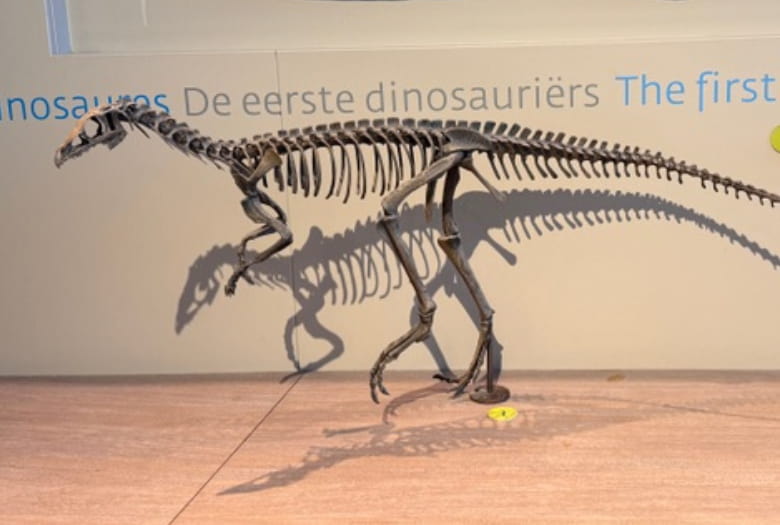
And several fellow herbivores, too:
- Ben the Plateosaurus, a skeleton from Frick in Switzerland, which took the team of palaeontologists and technicians 18 months to excavate and reconstruct. Plateosaurs were some of the first long-necked dinosaurs and, at 6.4 metres long, among the biggest dinosaurs of the Triassic period. Plateosaurus ate a variety of vegetation but may have also eaten insects and small animals.
- Dippy, a Diplodocus carnegii, like the one in Bologna.
- A Stegosaurus with its distinctive back plates.
- A Triceratops with its equally distinctive head crest and horns.
- This blog’s namesake, the Maiasaura. This skeleton comes complete with a reconstructed nest and a video of American palaeontologist Jack Horner discussing the discovery of Maiasaura eggs and Egg Mountain.
- Amurosaurus and Olorotitan, discovered in Russia by a joint team of Belgian and Russian palaeontologists.
- Hypsilophodon, one of the three specimens Richard Owen used to define dinosauria (the other two were the Iguanodon and Megalodon). Fossils of the small Cretaceous omnivore have been found in England and Romania.
- Zalmoxes, a small genus of Cretaceous bipedal herbivore discovered in Romania. It had a large triangular head and a beak.

You can also find Arkhane, the skeleton of a new Allosaurus species, in the Gallery of Evolution. We ran out of time to find Arkhane, so I can’t confirm the location. The Jurassic predator was discovered in Wyoming and grew to nearly 9 metres long.

The list is impressive, and I know I missed some.
New dinosaurs joining the Bernissart dinosaurs
Palaeontologists and technicians are currently preparing the skeleton of a long-necked dinosaur nicknamed “Dan”. Like Arkhane, Dan was discovered in the Morrison Formation in Wyoming, USA, and excavated in 2018/2019 and post-COVID.

Dan is a sauropod, similar to a Diplodocus, but probably belongs to a new genus. Based on the length of its femurs (170 cm!), experts estimate that Dan was approximately 20 metres long. He lived during the Upper Jurassic (155 MYA).
Dan is rare. It is one of the few sauropods that are remarkably complete (approx. 85% – one of the most complete sauropods to date) and partially articulated (bones in place as they would have been in life). It is even better preserved than the Diplodocus and Apatosaurus at the Carnegie Museum of Natural History in Pittsburgh. The entire process from discovery to assembly is also documented and reliable.
About 250 metres from Dan, the museum’s palaeontologists discovered the fossils of another sauropod, which are also being prepared and studied at the museum. Morris, named after the Morrisson Formation where he was found, is similar to a Camarasaurus and lived about 155 MYA.
Morris is an adolescent, around 10 to 12 metres long.
The team also uncovered fossils of a Dryosaurus, an early ancestor of the Bernissart Iguanodons, and the well-preserved pubis, shoulder blade and vertebrae of a Brachiosaur at the site.
Hopefully, we will soon hear whether Dan and Morris are new species and have another reason to visit the Bernissart dinosaurs again.


3. More than dinosaurs: The Mosasaurs
The Mosasaur Hall is in the basement below the Dinosaur Hall, near the in situ Bernissart dinosaurs.
In 1764, the giant fossils of the “great animal of Maastricht”, including a skull, were found in the St Peters chalk quarry in the Netherlands (the quarry spans underground into Belgium). Sixteen years later, a second skull was discovered.
French revolutionaries captured one of the skulls at the end of the 18th century and took it to Paris, supposedly for scientific value. It remains there today.
In 1808, naturalist Georges Cuvier concluded the skull belonged to a giant prehistoric marine lizard, which shared characteristics with monitor lizards. It became part of Cuvier’s theories of extinction, which later resulted in Darwin’s theory of evolution.
In 1822, Conybeare named the impressive beast the Mosasaurus, the lizard of the Meuse, after the Maas River that runs through Maastricht.
The Mosasaurus lived from 82 to 66 MYA and was one of the first Mesozoic marine reptiles known to science. It grew to be 17 or 18 metres long, though more recent estimates suggest the length was closer to 13 metres. Strong jaw muscles, large teeth, and a paddle-like tail made it the apex predator of the seas.
Mosasaurus fossils have been found in North and South America, Africa, Western Asia, Antarctica, and Europe (including Belgium).
Despite their prevalence during the Cretaceous seas (and their role in Jurassic World), few people knew much about the Mosasaurus. To remedy this, the Belgian Museum of Natural Sciences established the Mosasaur Hall, presenting a few of the specimens from its collection (one of the largest collections in the world).

4. Curators use the space well
There is much to admire about the Natural History Museum in London. It houses one of the world’s most important dinosaur collections in a gorgeous, ornate, Victorian building.
But the collection cannot breathe.
There is no space to step back to admire the fossils. They are too much to take in all at once.
You feel claustrophobic.
In contrast, the Dinosaur Hall of the Museum for Natural Sciences is spacious. The dinosaurs can breathe. With reason, too – it’s the largest hall in Europe that houses just dinosaurs.
While some areas focus on specific aspects – most obviously the Bernissart dinosaurs, but also polar dinosaurs, carnivores, and the Russian dinosaurs – the area remains open. The glass cage surrounding the eight standing Iguanodons and the tunnel between them separates the beasts from others in the collection, but not entirely.
Even with 38 species on display, the Museum is so large that little dinosaur fans can run about shrieking at all the fantastic dinosaur fossils without worrying they will annoy other visitors.
Open spaces also mean you can easily see your little dinosaur fan if they go exploring.
You won’t have to squeeze through a poorly lit maze but can stroll through a bright hall, meandering as you please or following the proposed route. Claustrophobic corners are mercifully absent. Social distancing is easy. There is zero to no risk of an elbow to the ribs. Your mind is free to imagine the magnificent beasts waking each evening and moving around the space.

The building, at least the dinosaur wing, is gorgeous with its ironwork and intricate marble mosaics. I love the juxtaposition of the original architecture and the modern glass ‘cage’ housing the Bernissart dinosaurs.
Yet the wrought iron staircases and balconies also allow you to analyse the specimens from every angle. You can pause, read and take in an exhibit without causing a traffic jam. It’s the perfect space to display dinosaurs, and it’s utilised brilliantly.

5. The exhibition is interactive
The curators have made the exhibition interactive and engaging for visitors, especially children.
Monitors located throughout the exhibition play videos in which experts explain certain fossils or finds, talk about working on a dig, etc. Many showcase research involving palaeontologists associated with the Museum.
Our LDA loved the Parasaurolophus skull. Pressing a button forces air through the skull to create the sound of a Parasaurolophus.
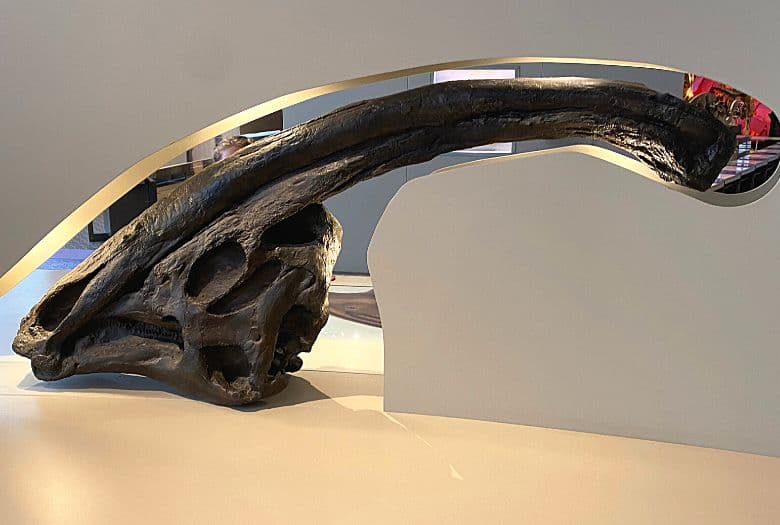
She also loved the Diplodocus “stomach” and reminded me to add it to this review.
The CGI Pachycephalosaurus was a hit with most children. A motion sensor guides what the little dinosaur does – dance, jump, head-butt the camera – mirroring the child’s movements. Even as a tween, Pachycephalosaurus was still a hit.
Puzzles and quizzes (on touch screens) also help keep visitors engaged.
Our LDA made a beeline for the little archaeologists’ pit, modelled on the bonebeds of Kundur (Russia). It’s a glorified sandpit; younger children love using brushes to find the ‘fossils’. She spent the first 20 minutes of our first visit with her bottom in the air and head down, digging. On our most recent trip, she was disappointed to find the dig site closed.

While some interactive elements target kids, other exhibits will draw in adults.
The PaleoLAB
Our most recent trip coincided with Belgian school holidays, which meant the PaleoLAB was open. This cunning Mamasaura had booked tickets that included the LAB.
The PaleoLAB is hands-on and offers various guided activities, including several fossils and minerals that visitors can touch. It is designed for school groups and visitors who are blind or partially sighted, but is open to everyone during (Belgian) school holidays.
It is impressive and varied and has activities for kids of all ages. Even the adults got involved trying to put the Stegosaurus bones back in the right place. Our LDA wants to visit again.
There are three time slots a day; some are in English. Many staff members speak enough English to explain how the Lab works. Entry to the PaleoLAB costs an additional EUR 4.

What else should you see?
Like many natural history museums, the Belgian Museum of Natural Sciences is not all about the Bernissart dinosaurs or even dinosaurs in general.
The Dinosaur Hall holds many exhibits designed to give context to life during the time of dinosaurs. These include, for example:
- Insects in tree resin found in Kudur (Russia)
- Various fossilised plants
- Fish, salamanders, and prehistoric crocodiles (Bernissartia) found in the mine together with the Bernissart dinosaurs
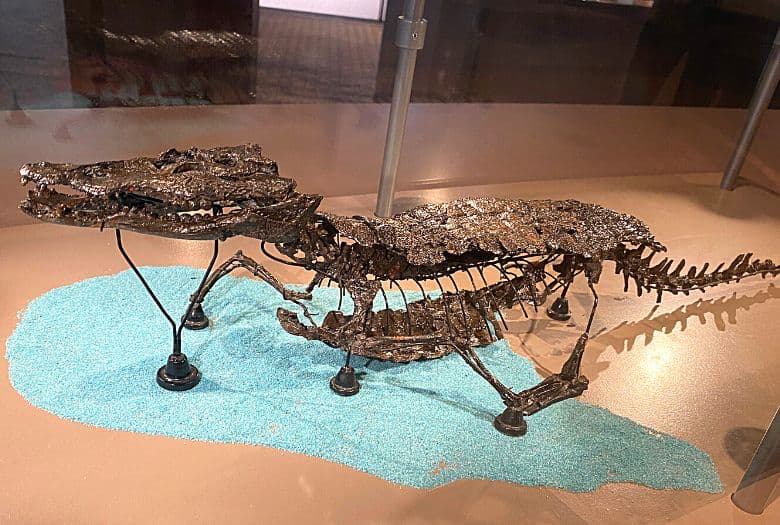
- Pterosaurs and

- Creatures from the Permian Age, including a magnificent Dimetrodon skeleton.

Other halls are worth visiting, too. We chose the Mineral Hall (because it’s next door to the Dinosaur Hall), the Living Planet, which reminded me of the Life Gallery at Naturalis (both are beautiful).
And, of course, the Gallery of Evolution if you want to see Arkhane the Allosaurus!
The temporary exhibitions are informative and fun. We saw one about bears, which featured a fun section on teddy bears.
Animazing, the new exhibition, examines the special survival skills and extraordinary abilities of 78 animals, such as the ability to sleep upright, photosynthesise, or see in every direction at once (runs until 29 August 2027).
Is there a language barrier?
All information and videos are in three languages: English, French and Dutch (Flemish). Typical for Brussels, we’ve heard several languages during our trips. This time there were larger groups from Spain and, I think, Croatia. The Museum is not just for Belgians. Clearly, ‘dinosaur’ is a universal language.
How do you get there?
I lived in Brussels for 12 years. I know the area.
Parking is a nightmare! The Museum sits on a narrow residential street that backs onto a park. When cars are parked on the street (when aren’t they?), cars can only pass single file. Parking at the Museum itself is limited to staff and a few disabled car parks. Wiertz Street is closed between Rue Belliard and the Museum. And if your car is not registered in Belgium, you will need to register for the LEZ. Be prepared to park further away and walk.
Or take public transport (we did).
- The Brussels-Luxembourg train station is a 5-minute walk (take exit 2).
- Take buses 34 or 80 to “Museum”. Buses 38 and 95 (to Italie or Luxembourg) stop a short walk from the Museum.
- Metro stops Trône (lines 2 and 6) and Maelbeek (lines 1 and 5) are both a 10-minute walk away.
Can you get something to eat?
I will be honest: the Dino Café is ok, but nothing special.
The sandwiches were quite tasty, but quite expensive by most standards (not by Brussels standards). But the ice creams were quite welcome on a summer’s day. There also don’t seem to be any issues with people buying a couple of drinks and having a picnic – groups can even book picnic benches.
But honestly, unless your little dinosaur is about to eat the exhibits, why would you buy something from the café when Brussels has some of the best French fries in the world? (My tips are The Fritkot at Place Flagey or Maison Antoine at Place Jourdan).
What are the facilities like?
The cloakroom is free – feel free to leave your coats, large bags and umbrellas (trust me, it’s Brussels: you’ll have an umbrella with you). Keyless lockers are also free (bags, including handbags, must go in the locker).
The toilets were clean and reminded me of school toilets (ambience is one level above clinical).
Lifts are slow and not easy to find without a map. They become even more difficult to find and use at closing time, when some are no longer accessible, making it difficult to exit the building.
What’s the shop like?
It’s fair and has a good selection of toy dinosaurs, books, minerals and semi-precious stones, postcards, T-shirts, mugs, and branded goods based on the themes and exhibits in the Museum’s halls. The shop is not as large, nor is the selection as extensive as the Natural History Museum shop in London, but there is still a range of souvenirs on offer.
And as with any museum shop, you know the goods are more likely to be anatomically correct than dinosaur gifts found online. Any purchases also contribute to the research of the Belgian Museum of Natural Sciences and the Museum’s exhibits.

Our favourite dinosaur museum (so far)
The Belgian Museum of Natural Sciences is an unknown, often underrated gem that is possibly the best dinosaur museum in the world. The large number and high quality of dinosaur exhibits, the Mosasaurus Hall, the awe-inspiring Bernissart dinosaurs, and the interactive nature of many exhibits all put it in the running for the title.
If you want to become part of an Iguanodon herd, make sure you visit this Museum!
Do you have a dinosaur museum you think would beat the Belgian Museum of Natural Sciences?

Save for later

More Reviews of Museums & Parks
Looking for recommendations on where to see some prehistoric beasts? Try these museums and parks!


