5+ excellent reasons to go fossil hunting in the Altmühl Valley (and where to go)
A spontaneous trip to the Altmühl Valley to hunt for Jurassic fossils was the highlight of our LDA’s summer holidays. Our ultimate guide tells you where to go, what you’ll need, how to do it and why you really should try it.


“Best day ever!” Her grin spread from ear to ear.
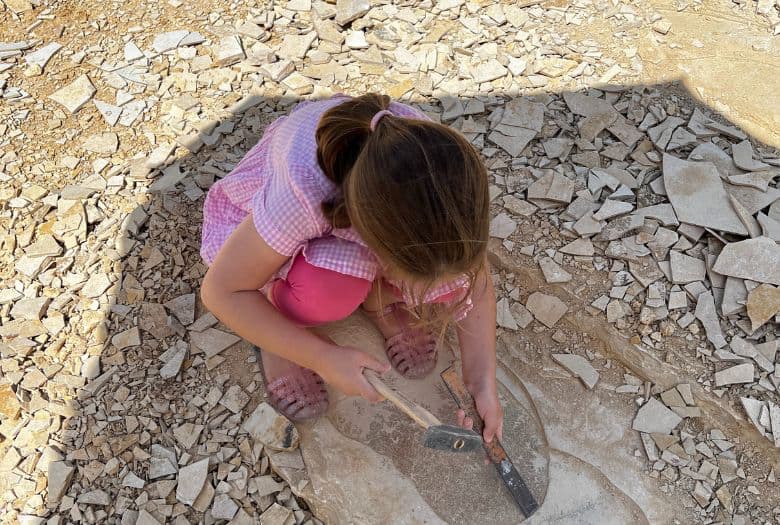
Sweat glued our LDA’s hair to her face. The fine dust made her sneeze and formed a paste in her mouth. And mine. The almost intolerable glare barely distracted her from her task.
Gasps of “Wow” interspersed grunts and constant hammering.
Only 45 minutes earlier, our LDA had been complaining of boredom. Now she’s vying with other future palaeontologists for the best spot to uncover the secrets of the Jurassic swamp.
Fossil hunting in the Altmühl Valley is exciting and educational. We’ve come up with at least 5 reasons you should go fossil hunting and have 5 sites in the Altmühl Valley where you can try to discover the thirteenth Archaeopteryx fossil.
Disclosure: Some of the links below are affiliate links. We may earn a small commission if you use these links to make a purchase. Thank you! Please read our full disclosure for more information.

Where is the Altmühl Valley?
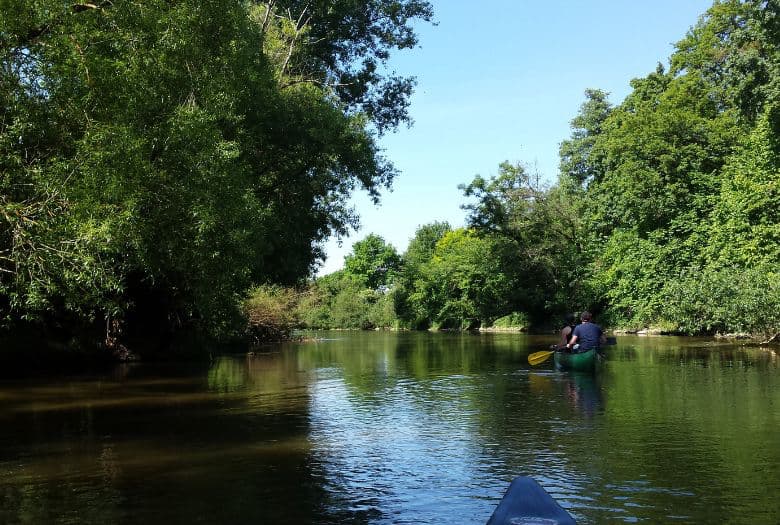
The Altmühl Valley is in Bavaria, Germany, north of Ingolstadt and south of Nuremberg. To the west is Augsburg, with UNESCO World Heritage Site Regensburg to the east. The Altmühl (or Old Mill) River runs through the valley.
The centre of the valley is Eichstätt. The town was founded in 741 on the site of an old Roman station. The only Catholic university in Germany is located in Eichstätt. Direct trains run between Eichstätt and both Munich and Nuremberg.
The Altmühltal Nature Park was established in July 1969, and it’s known for its hiking, cycling and canoeing opportunities, as well as its dinosaur finds (obviously, or why would we talk about it here?). With an area of 2,962 square km, it’s the fourth largest nature park in Germany.
Why is the area famous ?
Lithographic limestone from the Altmühl Valley has been quarried for centuries. This limestone has also yielded some of the most important dinosaur discoveries: 12 Archaeopteryx fossils.
During the Late Jurassic, the area was an archipelago at the edge of the Tethys Sea. Some areas were placid, devoid of oxygen and high in salinity. Any organism which ended up in the lagoons became buried in sticky carbonate mud, safe from scavengers because of the high salinity and low oxygen levels.
In addition to the Archaeopteryx, fossilised imprints of feathers, dragonfly wings and plants have been found. Over 600 species have been identified, including 29 pterosaurs, various marine reptiles and – probably – the Compsognathus.
What was the Archaeopteryx?
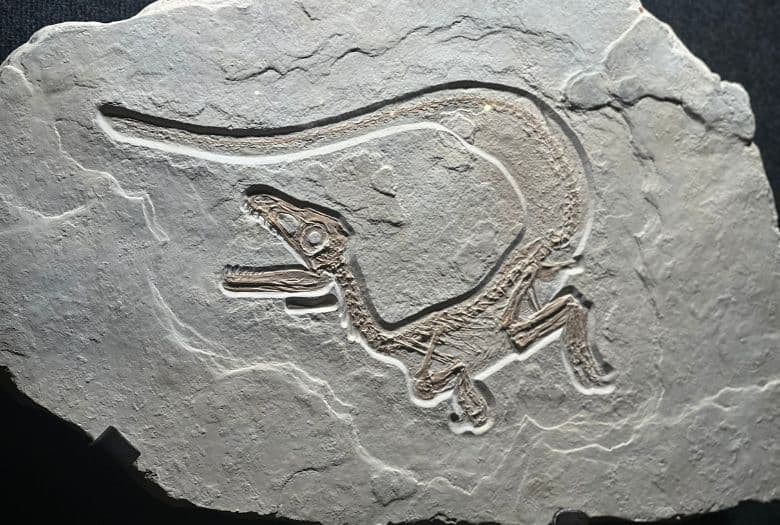
The Archaeopteryx – Greek for old wing – is a small avian dinosaur that lived around 150.8 to 148.5 million years ago in what is now Southern Germany.
It was about the size of a raven and grew up half a metre in length, weighed between 0.5 and one kilogram and had broad wings with a wingspan of 70 cm and well-developed flight feathers. Its feathers were similar in structure to a modern bird and – according to spectrometry – black. Archaeopteryx could probably fly, too, but in short bursts like a pheasant.
Other characteristics were more like a theropod dinosaur. The Archaeopteryx had small and sharp teeth (it was a carnivore), it had three fingers with claws on each wing, and, like the Dromaeosaurus, it had a killing claw on each foot. Like other Jurassic dinosaurs, it had a long, lizard-like, bony tail.
These features make Archaeopteryx a transitional fossil which helps us understand the evolutionary chain connecting non-avian dinosaurs and birds.
Archaeopteryx was named in 1861 from a single feather. Although it’s the initial holotype, for many years, experts could not agree that the feather belonged to an Archaeopteryx.
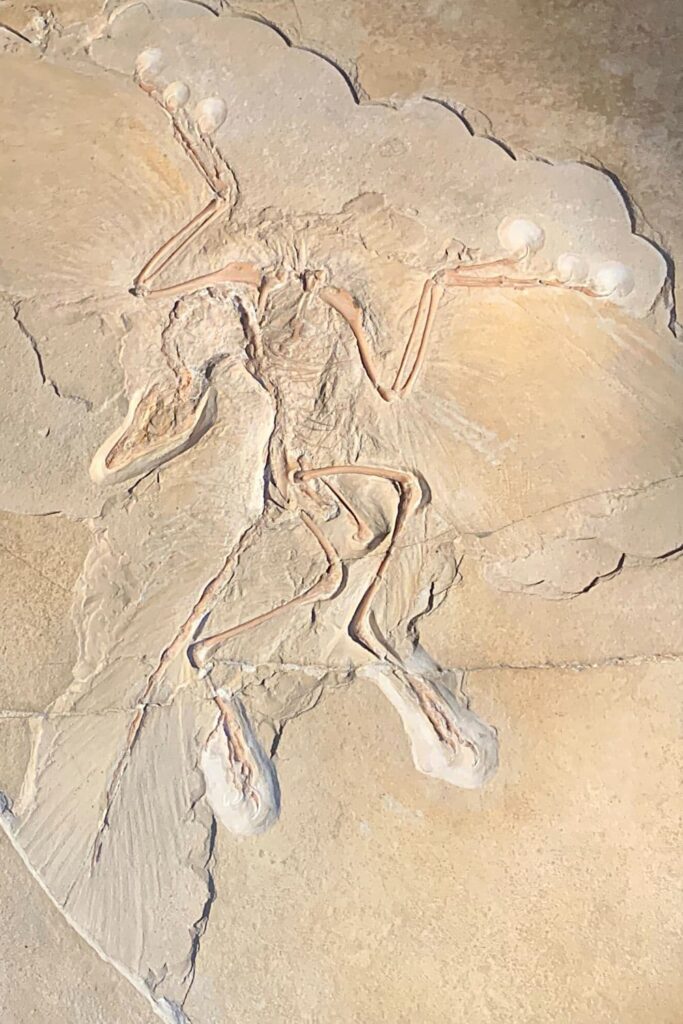
Over the years, twelve fossil specimens of Archaeopteryx have been found. All the fossils come from the limestone near Eichstätt and Solnhofen, in the Altmühl Valley.
- The first fossil – known as the London fossil – was found in 1861 near Langenaltheim, to the west of Solnhofen. A local physician received it in return for medical services and sold it to the Natural History Museum in London. Richard Owen described the specimen in 1863 and Charles Darwin took a keen interest, commenting on it in the 4th edition of his “On the Origin of Species”. This specimen is missing most of its head and neck.
- The Berlin specimen, the most complete specimen. A farmer found the fossil in 1874 on the Blumenberg (Flower Hill) near Eichstätt and sold it to an innkeeper for the money to buy a cow. The innkeeper sold the fossil to the son of the physician, and the son put it up for sale. The Natural History Museum in Berlin purchased the specimen with financing from Ernst Werner von Siemens (the founder of Siemens).
- The Maxberg Specimen was discovered in 1956 near Langenaltheim, where the London fossil was found. This specimen is missing a head and tail, but the whole specimen went missing from the Maxberg Museum in Solnhofen in 1991.
- The Haarlem Specimen is housed in the Teylers Museum in Haarlem, the Netherlands. This specimen was the first to be discovered (in 1855) but was first described as a pterodactyl. In 1970, John Ostrom, who showed that dinosaurs were more like birds than lizards, reclassified the specimen which consists mainly of limb bones. Recent examinations proved that the Haarlem specimen is not an Archaeopteryx but a bird-like carnivorous predator.
- The Eichstätt specimen, currently housed at the Jura Museum in Eichstätt, is the smallest specimen with the second-best head. It was found in 1951 in Workerszell, north of Eichstätt.
- The Solnhofen specimen, the largest known specimen, was found in the 1970s near Eichstätt and is currently housed in the Bürgermeister-Müller Museum in Solnhofen. Friedrich Müller – after whom the museum is named – originally classified it as a Compsognathus. Parts of the neck tail, backbone and head are missing.
- The Munich specimen was discovered in 1992 near Langenaltheim and is housed by the Paläontologisches Museum in Munich. Only the front of its face is missing.
- The Daiting specimen was discovered in 1990 at Daiting to the southwest of Eichstätt. The specimen went missing for several years and was nicknamed “Phantom“. It is now privately owned.
- The Bürgermeister-Müller specimen, found in 2000 housed by the museum of the same name. The remains are of a single wing, earning it the nickname “chicken wing”.
- The Thermopolis specimen, the most complete remains, was donated to the Wyoming Dinosaur Center in Thermopolis. This specimen shows that the Archaeopteryx did not have a “backward toe” that would have allowed it to perch on branches. The lack of this toe may experts conclude that the Archaeopteryx was a therapod.
- An unnamed eleventh specimen was announced in 2011. It’s one of the more complete specimens and revealed previously unknown information about the Archaeopteryx’s feathers. The Senckenberg Museum in Frankfurt am Main has the fossil on display in a new “feathered dinosaurs” exhibit.
- In 2010, an amateur collector discovered the twelfth specimen at Schamhaupten quarry, southwest of the Dinosaur Museum Altmühltal. Experts first thought the specimen was a pterosaur, but later classified it as an Archaeopteryx. The complete and articulated skeleton is the only specimen without feathers and is older than other specimens. After careful preparation, the specimen is on display in a purpose-built space at the Museum, where we saw it this summer.
- In April 2018, the wing of a possible 13th fossil was found at the quarry at Mühlheim near Mörnsheim. In May 2019, Professor Oliver Rauhut from the Bavarian State Collection for Palaeontology and Geology announced that the wing belonged to a new, larger ancient bird named Alcmonavis after the Celtic name for Almühl, Alcmona.

Can you go fossil hunting in the Altmühl Valley today?
Obviously, yes.
The area and its limestone quarries are an “open window on the mysterious Jurassic world”. We’ve found 5 places where you can go fossil hunting in the Altmühl Valley for a few euro or even for free.
In other regions, you’ll pay at least 10 times that amount. And you don’t have to negotiate complicated agreements with land owners to do it.
Unless you find something truly spectacular (from a scientific perspective), you can take your fossil finds home with you. An amateur palaeontologist found a fossilised turtle recently and the quarry had a complete copy of it made for him to take home. If it is something brand new, palaeontologists might even name it after you!
The quarries are open from the Easter school holidays to the end of the Autumn school holidays (in Bavaria). This is generally from 1 April to the end of October/first week in November (check the websites to confirm).
Fossil quarry (Fossiliensteinbruch) Blumenberg near Eichstätt
https://fosseb.de
Kinderdorfstrasse, 85072 Eichstätt
Open Tuesday to Sunday, 10 am to 4 pm
Children EUR 3; Adults EUR 6; Family EUR 10
Tool hire: EUR 2.
This is the quarry we visited and where the Berlin specimen was found (though we didn’t discover that until later). Our LDA had an absolute ball, despite the heat, dust, and inappropriate footwear.
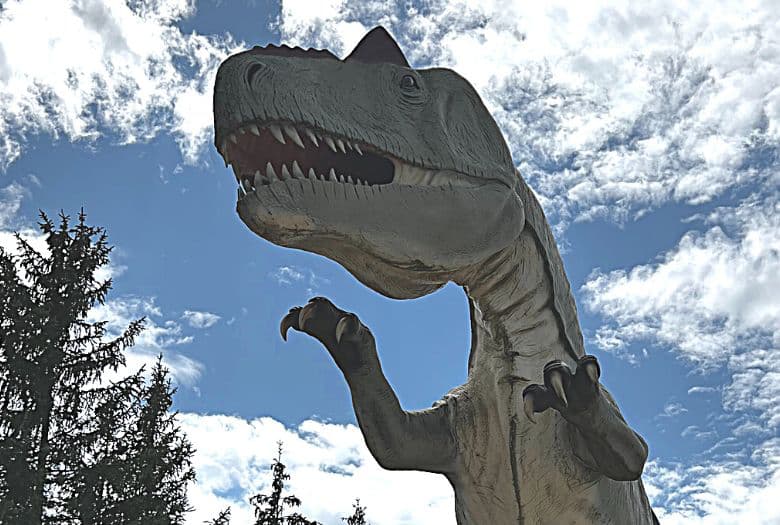
When she was satisfied with her finds and ensured they were well wrapped and ready for transport, she played on the playground and admired the life-sized Allosaurus, the largest Jurassic predator. Drinks and ice creams as well as fossils are available for purchase, too.
Fossil quarry Mühlheim near Mörsheim
https://www.besuchersteinbruch.de
Tagmersheimer Strasse, 91804 Mörnsheim-Mühlheim
Open daily, 10 am to 4 pm
Children EUR 4; Adults EUR 8; Family EUR 14
Tool hire: EUR 1 plus deposit
This is where the Alcmonavis was found and – it seems – the quarry has yielded the most varied fossil finds in recent years, including the Jurassic turtle. Drinks and fossils are available for sale and there’s a barbecue you can use (BYO coals).
Hobby-quarry Solnhofen
http://www.hobbysteinbruch-solnhofen.de
Frauenberger Weg, 91807 Solnhofen
Open daily, 10 am to 5 pm
Children EUR 4.50; Adults EUR 6; Family EUR 13
Tool hire: EUR 0.50 per tool
We were heading here via Eichstätt when we diverted to the Blumenberg. The famed London specimen was discovered nearby.
In addition to fossils, there are cold and hot drinks and a range of simple hot food for sale (Bratwurst, chips, cheeseburgers). Tool hire is cheap, but the hammers may be a little big for the youngest palaeontologists.
The quarry closes in wet weather.
Fossil-quarry Schamhaupten near Altmannstein
For more information (only in German): https://altmannstein.de
Follow the signs from the centre of Altmannstein
Open daily, 10 am to 6 pm
Entry is free
Tool hire: Not available
This quarry is further east than the others on this list. The most recent Archaeopteryx was found nearby (the exact location has not been revealed). Fossil hunting is free, but you must bring your own tools.
Fossil collection point Titting
https://titting.de
The site is above the town, follow the signs
Open daily
Entry is free
Tool hire: From the Tourist Information (open 10 am to 12 pm from 1 April to 31 October and from 2 pm to 4 pm (Monday to Friday, except Wednesdays) from 1 May to 30 September)
Fossil hunting is free, but you can only hire the necessary tools from the Tourist Information Centre. The limestone is rich in ammonite fossils.
You can also go fossil hunting for real fossils at the Dinosaur Museum Altmühltal. They have slabs of limestone from quarries in the area, which you can split to (hopefully) reveal a fossil.
What type of fossils will you find?
Archaeopteryx findings are extremely uncommon. At least seven pterosaur fossils are found for every Archaeopteryx when fossil hunting in the Altmühl Valley, but even such finds are exceptional. All you need is luck: amateur palaeontologists have discovered many of the Archaeopteryx fossils.
While you’re unlikely to find an Archaeopteryx, you are also unlikely to leave empty-handed. Some of the more common fossils found in the Altmühl Valley include:
- Feather stars, AKA sea lilies. These echinoderms are related to starfish and sea urchins. They glided through the water, using their ten arms to feed on plankton They are so common, quarry workers nicknamed some limestone layers “button layers”.
- Ammonites. The fossils of this extinct marine mollusc – at least those found in the Altmühl Valley – range in size from a cent piece to the size of a slice of bread.
- Coprolites, AKA Lumbricaria. These fossils look like worms but are the fossilised faeces of fish or ammonites.
- Calcite, or calcium carbonate (lime) in crystallised form. Many of the feather star fossils have a body of glittering calcite.
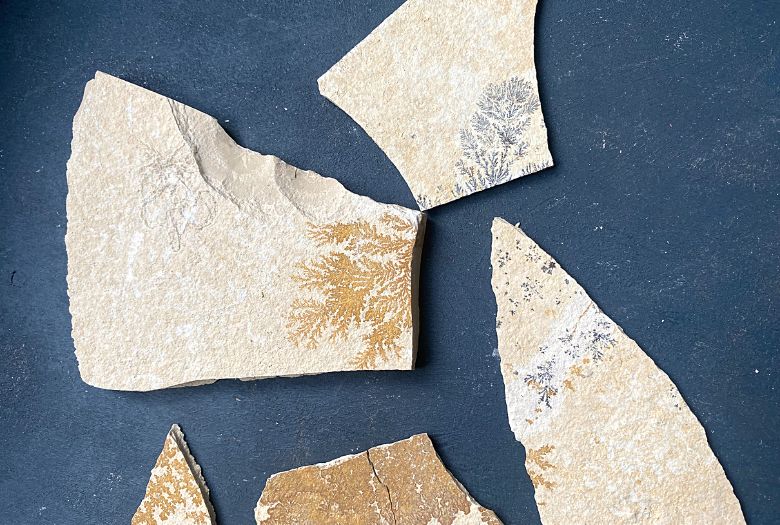
- Dendrites, which look like little leaves or trees (the name means tree in Greek). These pseudofossils form when water rich in manganese and iron penetrates fissures in rocks and flows along fractures and between layers in limestone, depositing crystals as they go. The resulting crystal has a multi-branching form, like a tree.
We found dendrites. They look beautiful and we told our LDA they were probably fossilised Jurassic pond scum. Our LDA felt she had uncovered something significant, and I wasn’t going to change that misconception.
What you need for fossil hunting
You need a few tools for fossil hunting in the Altmühl Valley or any similar limestone deposits.
Quarries can be steep and slippery. We learnt the hard way – wear sturdy shoes (and not sandals…).
To remove and split the slabs of limestone you’ll need a hammer and flat chisel. You might have some in your toolbox, but you can rent some at most of the quarries in the Altmühl Valley for a few euro.
Uncovering the fossils is dusty work and little bits of rock can even fly off. If it gets in your eyes, it can cause significant damage. We like these safety glasses because they fit close to the face and the elastic strap makes it easier for little dinosaur fans to keep them on (and they come in pink).
There is almost no shade or protection from the weather in a quarry. We found a golf umbrella useful for shade. A drink bottle full of water helps with the grit and dust. And wear sunscreen.
Some of the fossils are quite small. A magnifying glass will help find the fossils (these shatterproof ones are great).
To keep any finds safe for the trip home, some newspaper or bubble wrap would be useful and a bucket (love this collapsible one) or basket or something similar to transport them.
If it has rained recently, the quarry will be dirty. A change of clothes and a plastic bag for the muddy clothes are recommended.
If you can, go fossil hunting in the Altmühl Valley – or wherever you are going fossil hunting – early in the day.
Get our dinosaur colouring books
Sign up for our newsletter
How to get a fossil out of the stone
Even future palaeontologists can work with the soft limestone layers. Take care, limestone breaks easily.
As you can see from the Archaeopteryx fossils, fossils found in the limestone are generally kept in the limestone. The trick, therefore, is to carefully remove the plate of the limestone with the fossil in it.
And often you will not know if you have found something until you have removed and split the slab of limestone.
How to do it:
- First loosen a “section” in the limestone. Tap the chisel against the stone to carefully lift a section to help release it.
- Examine the section for the seams. Line the tip of the chisel up with the seams and carefully tap along the seams to remove the section from the rest of the rock.
- Carefully tap the chisel around the edge of the section to split the section into two layers.
- Carefully separate the layers and examine for fossils. In most cases, the layers will separate easily. If you can, use a magnifying glass so you don’t miss any.
Other prehistoric sites in the Altmühl Valley
While hunting for real fossils is exciting for little dinosaur fans, numerous other sites in the Altmühl Valley will also interest fans of the prehistoric.
The quarries are closed in Winter. Luckily, many of these other sites are open in the colder months.
The Jura Museum in Willibaldsburg Castle in Eichstätt.
The natural history museum showcases fossils found in the surrounding area, including one of the Archaeopteryx fossils, various marine reptiles and pterosaurs and a well-preserved skeleton on the Juravenator (Jurassic Hunter). It also has aquariums with various modern-day descendants of the Jurassic marine life.
The Willibaldsburg Castle is one of the most beautiful settings for a natural history museum. While you are there, check out the Hortus Eystettensis (based on the renaissance garden and botanical compendium of the same name), and climb the observation tower for views over Eichstätt and the Altmühl Valley.

Museum Bergér/Harthof near Eichstätt
In 1970, the Bergér family established a unique museum. All of the over 800 fossils on display were found in the quarries owned by the family, no more than 1 km from Eichstätt. It even has a copy of the Berlin Archaeopteryx, which was found in the Blumenberg quarry, and a special chamber for holotypes.
Visit the museum before visiting the Blumenberg quarry. Staff at the museum will show you how to remove the limestone and split it to reveal the fossils and explain which types of fossils you will find.
The Museum is closed over winter.

What is a holotype?
A holotype is a single type specimen of a species that is used as the benchmark fossil. The description and name of a new species are based on that single specimen. Where palaeontologists think that another fossil belongs to the same species, they will compare those fossils to the holotype. A specimen may be the holotype because it was first found and formally described (like the fossilised Archaeopteryx feather), or because it shows various characteristics that define the species (such as the Berlin specimen).
Bürgermeister-Müller Museum, Solnhofen
Mayor Müller’s Museum in Solnhofen has not one, but two specimens of the Archaeopteryx (though one is really only wings). The museum is set up like a zoo, with each room showcasing different types of animals. The only difference is the animals are Jurassic fossils.
Dinosaur Museum Altmühltal
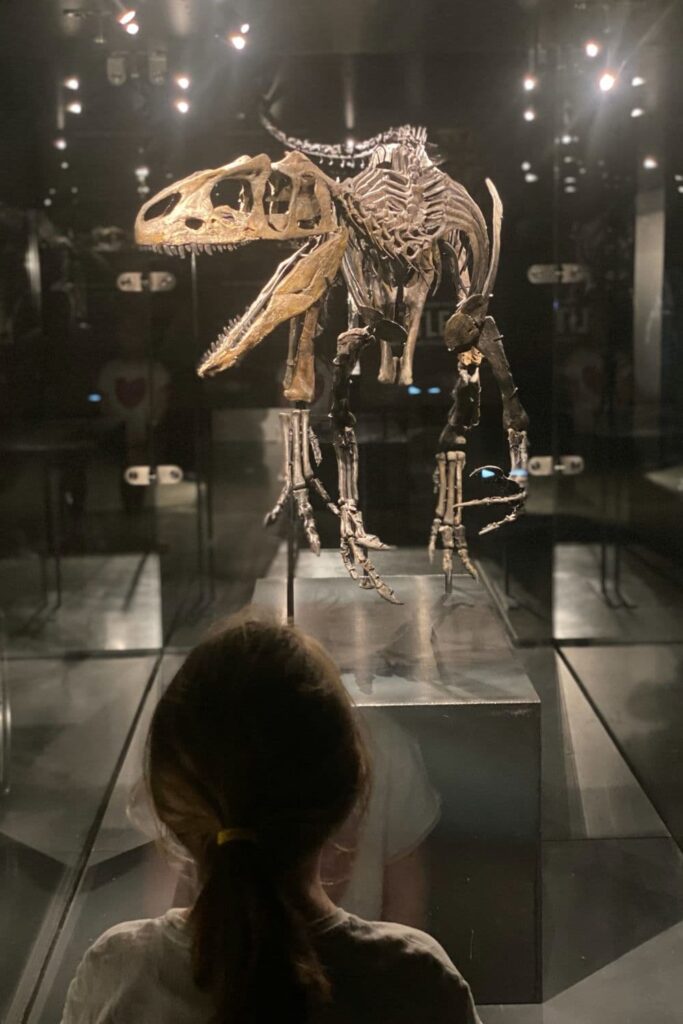
We’ll have a separate post on this wonderful museum soon. The Dinosaur Museum Altmühltal has spent the last few years building up its collection of truly unique specimens. In addition to the 12th Archaeopteryx, they have a teenage T-Rex and the youngest Allosaurus ever found.
Little dinosaur fans can take a walk through the forest and through history admiring and cuddling various dinosaurs, play on the playgrounds and giant airbag and even do some more fossil hunting.
We’ve been twice. Our LDA wants to go again. Soon.
Other sites
The forces of nature that resulted in the significant limestone and fossils in the area have also yielded other natural wonders. These include the Schulerloch show caves near Essing with its stalactites and stalactites, the Devil’s Pulpit (Teufelskanzel) and 12 Apostles rock formations near Solnhofen and the Nördlinger Ries meteorite crater.
5+ reasons to go fossil hunting in the Altmühl Valley
- The Altmühl Valley provides a unique window into the Jurassic past. Most other (public) fossil sites are much younger and the finds are not as varied.
- The fossils are so numerous in the Valley, you’re almost guaranteed to discover something (even if you only find dendrites).
- You’ll feel accomplished and proud when you finally extract your find – it takes patience and persistence!
- The anticipation and excitement of revealing your finds is amazing. Will you discover the next Archaeopteryx?
- Unless you find something truly spectacular (from a scientific perspective), you can take your fossil finds home with you. An amateur palaeontologist found a fossilised turtle recently and the quarry had a complete copy of it made for him to take home. If it is something brand new, palaeontologists might even name it after you!
- It’s cheap or free! In other regions, you’ll pay at least 10 times that amount. And you don’t have to negotiate complicated agreements with land owners to do it.
- You’re developing very useful skills for future palaeontologists.
You might end up dirty and dusty. Your mouth may feel like sandpaper. But you won’t hear the dreaded, “I’m bored!”
Have you seen any of the Archaeopteryx fossils? Have you been fossil hunting in the Altmühl Valley or any other fossil hotspots?

Save for later!